Plataforma d'espectroscòpia molecular i microscòpia òptica

La instal·lació d'espectroscòpia i microscòpia molecular de l'ICN2 és un conjunt de laboratoris que proporcionen accés a equips d'última generació per a la caracterització fisicoquímica i estructural de materials a macro i nanoescala. A més de l'anàlisi rutinària, també ofereix una gamma de tècniques i aplicacions altament exigents, satisfent així la necessitat dels investigadors d'anàlisis científiques bàsiques i específiques. A més del suport tècnic i la formació per a equips operats per l'usuari, els membres de la instal·lació també realitzen estudis de casos per informar i assessorar els investigadors i/o desenvolupar dispositius que millorin el rendiment dels equips existents.

Blocs de contingut

Imatges

FTIR Spectroscopy

FTIR Spectroscopy

Tensor 27 FTIR Spectrometer (Bruker)

The Tensor 27 is a spectrometer suitable for routine applications as well as for demanding laboratory analysis in the middle infrared (MIR). Measurements can be performed using an Attenuated Total Reflection device (ATR, MVP-ProTM Harrick Scientific Products) device or KBr pellets.

Applications: chemical characterization of powders, liquid materials (not solutions), films and textiles.

PMA 50 module (Bruker)

PMA 50 is a module that operates coupled to the  Tensor 27 FTIR spectrometer . It can perform polarization modulation infrared reflection absorption spectroscopy (PM-IRRAS) and vibrational circular dichroism (VCD) experiments in the MIR.

Applications:

PM-IRRAS allows for the high-sensitivity analysis of ultrathin layers and coatings, monolayers and submonolayers and biomolecules, deposited on surfaces, especially conducting ones (Au, Cu, Pd, alloys, etc). It provides information, not only about the composition of the deposited materials, but also about their organization, conformation and orientation.

Thanks to the characteristics of PM-IRRAS, samples can be measured without a reference and the yielded spectra are free from atmospheric interferences, such as carbon dioxide and water vapour.

VCD is a technique that provides 3D information of molecules. It can be applied for determining the secondary structure of proteins and peptides, the purity of enantiomers and also their absolute configuration by comparison with previously reported data or with data obtained by means of theoretical simulations.

UV-Vis Spectroscopy

UV-Vis Spectroscopy

Cary 4000 UV-Vis Spectrophotometer (Agilent Technologies)

The Cary 4000 is a high-end double beam UV-Visible spectrophotometer that offers a huge versatility of set-ups and accuracy.

Applications:

Characterization of liquids and films in the range 175-900 nm, and also powders by means of a diffuse reflectance accessory (DRA) in the range 300-800 nm. This device can be setup for performing reflectance, transmittance or absorbance measurements of diffuse, specular, or mixed samples, not only powders, but also other highly diffractive samples, like nanoparticles dispersions, rough films and surfaces, etc.

A liquid cell holder can be setup for performing variable temperature experiments using a thermostatic bath circulator.

Lambda 25 Spectrophotometer (Perkin Elmer)

Multi-range Spectroscopy

Multi-range Spectroscopy

Vertex 80 Spectrometer (Bruker)

Hyperion 2000 Microspectrometer (Bruker)

The Hyperion 2000 is a FTIR/Vis-NIR microspectrometer that operates coupled to the Vertex 80. It allows for the microscopic inspection of samples and the obtaining of FTIR/Vis-NIR spectra in the selected spots, thus providing chemical and optical information of specific regions.

Available objectives:
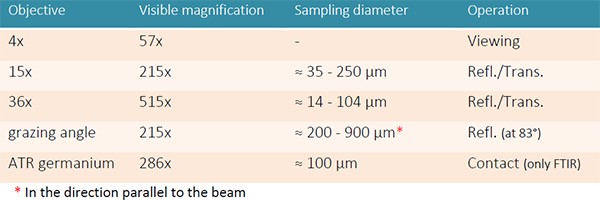


Applications:

Characterization of specific spots in solid samples (films, coatings, powders, textiles, etc.). The automatization of the stage allows for the obtaining of chemical mappings of large regions.

Visible and infrared polarizers are available.

Dynamic Light Scattering (DLS) and Zeta Potential

Dynamic Light Scattering (DLS) and Zeta Potential

Zetasizer Nano ZS (Malvern)

This equipment can provide information about the size and the colloidal stability (if it’s based on electrostatic repulsion) of particles, vesicles, micelles, proteins, etc. that are suspended in a liquid medium. Applications: determination of the size (0.6nm to 6μm) and zeta potential (for particles whose sizes are between 5nm to 10μm) of colloids.

A micro volume (12 μl) quartz cell for DLS and an universal dip cell for the determination of zeta potential in organic solvents are available.

Contact angle

Contact angle

Drop Shape Analyzer DSA25S (KRÜSS)

Contact angle is useful for analysing the wettability of solid substrates, a very simple technique that can provide quick information about the nature of a surface (both chemical and morphological).

The DSA25S, thanks to its versatility, offers the possibility of obtaining other interesting information about materials (solids and liquids) beyond wettability.

Applications:

  • Static and dynamic contact angle

  • Surface free energy of solids.

  • Surface and interfacial tension of liquids.

  • Advancing and receding contact angles and evaluation of a roll off angle by tilting table method.

The DSA25S features a high speed camera with a resolution of, at least, 1920 x 1200 px, and an automatic software-controlled dispenser and tilting stage.

Optical microscopy

Optical microscopy

Nikon ECLIPSE LV100D (Nikon)

The Nikon ECLIPSE system is a straightforward but reliable microscope of especial interest in material science. It features 5x, 10, 20x, 50x and 100x magnification objectives and polarizing filters for the analysis of crystalline domains, liquid crystals and self-assembling organic materials, among others.

Dades provisionals

Javier Saiz Poseu |  javier.saiz@icn2.cat  |  ORCID 

Javier Saiz Poseu |  javier.saiz@icn2.cat  |  ORCID 

Gustavo Ceballos | Cap de la Divisió de Suport a la Recerca - Unitat d'Instrumentació |   gustavo.ceballos@icn2.cat  |   ORCID 

Centres CERCA

Propietaris

Llista Centres CERCA

Equipament i Serveis

TÈCNIQUES DISPONIBLES Espectroscòpia i microscòpia FT-IR Espectroscòpia UV-vis Dispersió dinàmica de la llum i potencial zeta Microscòpia òptica Microscòpia de fluorescència Angle de contacte estàtic MICROSCÒPIA ÒPTICA AVANÇADA L'ICN2 disposa d'un microscopi òptic Axio Observer Z1m (ZEISS) a les seves instal·lacions. És un microscopi òptic invertit d'alta resolució i versàtil que permet a l'usuari obtenir coneixements precisos i fiables sobre una àmplia gamma de tipus de mostres, com ara materials de mida nano/micro, dispositius nano/microscòpics, cèl·lules · Cèl·lules vives, etc. ESPECTROSCÒPIA FT-IR L'espectroscòpia IR es basa en l'absorció de la radiació infraroja que condueix a una transició d'un mode vibracional a un de més energètic. Les freqüències absorbides per les molècules són característiques de la seva estructura. Per tant, aquesta tècnica és una eina potent per a l'anàlisi qualitativa, tot i que també es pot utilitzar quantitativament. Tot i que es basen en els mateixos fenòmens físics pel que fa a la interacció entre la radiació i la matèria, els espectròmetres d'infraroig actuals han evolucionat en la manera com irradien la mostra, substituint els monocromadors anteriors per interferòmetres, donant lloc a l'espectroscòpia d'infrarojos per transformada de Fourier (FT-IR) més ràpida.

Categorització

Dominis RIS3CAT

Dominis RIS3CAT
CERCA GINYS Categories

GINYS-ICN2-006

Procediment d'accés i tarifes

Obre