Molecular spectroscopy and optical microscopy platform

The ICN2 spectroscopy and molecular microscopy facility is a set of laboratories that provide access to state-of-the-art equipment for the physicochemical and structural characterization of macro- and nano-scale materials. In addition to routine analysis, it also offers a range of highly demanding techniques and applications, thus satisfying the need for researchers for basic and specific scientific analysis. In addition to technical support and training for user-operated equipment, facility members also conduct case studies to inform and advise researchers and / or develop devices that improve the performance of existing equipment.

Facility

Images

FTIR Spectroscopy

FTIR Spectroscopy

Tensor 27 FTIR Spectrometer (Bruker)

The Tensor 27 is a spectrometer suitable for routine applications as well as for demanding laboratory analysis in the middle infrared (MIR). Measurements can be performed using an Attenuated Total Reflection device (ATR, MVP-ProTM Harrick Scientific Products) device or KBr pellets.

Applications: chemical characterization of powders, liquid materials (not solutions), films and textiles.

PMA 50 module (Bruker)

PMA 50 is a module that operates coupled to the  Tensor 27 FTIR spectrometer . It can perform polarization modulation infrared reflection absorption spectroscopy (PM-IRRAS) and vibrational circular dichroism (VCD) experiments in the MIR.

Applications:

PM-IRRAS allows for the high-sensitivity analysis of ultrathin layers and coatings, monolayers and submonolayers and biomolecules, deposited on surfaces, especially conducting ones (Au, Cu, Pd, alloys, etc). It provides information, not only about the composition of the deposited materials, but also about their organization, conformation and orientation.

Thanks to the characteristics of PM-IRRAS, samples can be measured without a reference and the yielded spectra are free from atmospheric interferences, such as carbon dioxide and water vapour.

VCD is a technique that provides 3D information of molecules. It can be applied for determining the secondary structure of proteins and peptides, the purity of enantiomers and also their absolute configuration by comparison with previously reported data or with data obtained by means of theoretical simulations.

UV-Vis Spectroscopy

UV-Vis Spectroscopy

Cary 4000 UV-Vis Spectrophotometer (Agilent Technologies)

The Cary 4000 is a high-end double beam UV-Visible spectrophotometer that offers a huge versatility of set-ups and accuracy.

Applications:

Characterization of liquids and films in the range 175-900 nm, and also powders by means of a diffuse reflectance accessory (DRA) in the range 300-800 nm. This device can be setup for performing reflectance, transmittance or absorbance measurements of diffuse, specular, or mixed samples, not only powders, but also other highly diffractive samples, like nanoparticles dispersions, rough films and surfaces, etc.

A liquid cell holder can be setup for performing variable temperature experiments using a thermostatic bath circulator.

Lambda 25 Spectrophotometer (Perkin Elmer)

Multi-range Spectroscopy

Multi-range Spectroscopy

Vertex 80 Spectrometer (Bruker)

Hyperion 2000 Microspectrometer (Bruker)

The Hyperion 2000 is a FTIR/Vis-NIR microspectrometer that operates coupled to the Vertex 80. It allows for the microscopic inspection of samples and the obtaining of FTIR/Vis-NIR spectra in the selected spots, thus providing chemical and optical information of specific regions.

Available objectives:
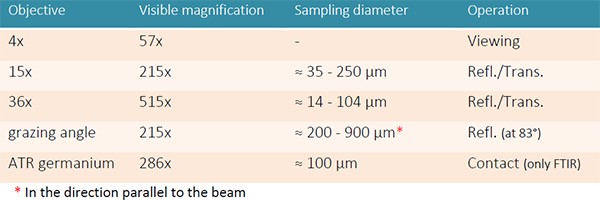


Applications:

Characterization of specific spots in solid samples (films, coatings, powders, textiles, etc.). The automatization of the stage allows for the obtaining of chemical mappings of large regions.

Visible and infrared polarizers are available.

Dynamic Light Scattering (DLS) and Zeta Potential

Dynamic Light Scattering (DLS) and Zeta Potential

Zetasizer Nano ZS (Malvern)

This equipment can provide information about the size and the colloidal stability (if it’s based on electrostatic repulsion) of particles, vesicles, micelles, proteins, etc. that are suspended in a liquid medium. Applications: determination of the size (0.6nm to 6μm) and zeta potential (for particles whose sizes are between 5nm to 10μm) of colloids.

A micro volume (12 μl) quartz cell for DLS and an universal dip cell for the determination of zeta potential in organic solvents are available.

Contact angle

Contact angle

Drop Shape Analyzer DSA25S (KRÜSS)

Contact angle is useful for analysing the wettability of solid substrates, a very simple technique that can provide quick information about the nature of a surface (both chemical and morphological).

The DSA25S, thanks to its versatility, offers the possibility of obtaining other interesting information about materials (solids and liquids) beyond wettability.

Applications:

  • Static and dynamic contact angle

  • Surface free energy of solids.

  • Surface and interfacial tension of liquids.

  • Advancing and receding contact angles and evaluation of a roll off angle by tilting table method.

The DSA25S features a high speed camera with a resolution of, at least, 1920 x 1200 px, and an automatic software-controlled dispenser and tilting stage.

Optical microscopy

Optical microscopy

Nikon ECLIPSE LV100D (Nikon)

The Nikon ECLIPSE system is a straightforward but reliable microscope of especial interest in material science. It features 5x, 10, 20x, 50x and 100x magnification objectives and polarizing filters for the analysis of crystalline domains, liquid crystals and self-assembling organic materials, among others.

Provisional Contacts

Javier Saiz Poseu | Research technician at the Spectroscopy and Molecular Microscopy Facility |  javier.saiz@icn2.cat  |  ORCID 

Javier Saiz Poseu |  javier.saiz@icn2.cat  |  ORCID 

Gustavo Ceballos | Head of Research Support Division - Instrumentation Unit |  gustavo.ceballos@icn2.cat  |  ORCID 

CERCA Institutes

Owners

Centres CERCA List

Equipments & Services Offered

AVAILABLE TECHNIQUES Spectroscopy and FT-IR microscopy UV-vis spectroscopy Dynamic light scattering and zeta potential Optical microscopy Fluorescence microscopy Static contact angle ADVANCED OPTICAL MICROSCOPY ICN2 has an Axio Observer Z1m (ZEISS) optical microscope in its facilities. It is a high-resolution and versatile inverted optical microscope that allows the user to gain accurate and reliable knowledge about a wide range of sample types, such as nano / micro size materials, nano / microscopic devices, cell · Living cells, etc. FT-IR SPECTROSCOPY IR spectroscopy is based on the absorption of infrared radiation that leads to a transition from a vibrational mode to a more energetic one. The frequencies absorbed by molecules are characteristic of their structure. Therefore, this technique is a powerful tool for qualitative analysis, although it can also be used quantitatively. Although based on the same physical phenomena in terms of the interaction between radiation and matter, current IR spectrometers have evolved in the way they radiate the sample, replacing previous monochromators with interferometers, leading to spectroscopy. faster Fourier transform (FT-IR) infrared.

Categorització

RIS3CAT domains & other

RIS3CAT Domains
CERCA GINYS Categories

GINYS-ICN2-006

Access procedure & Fares

Open